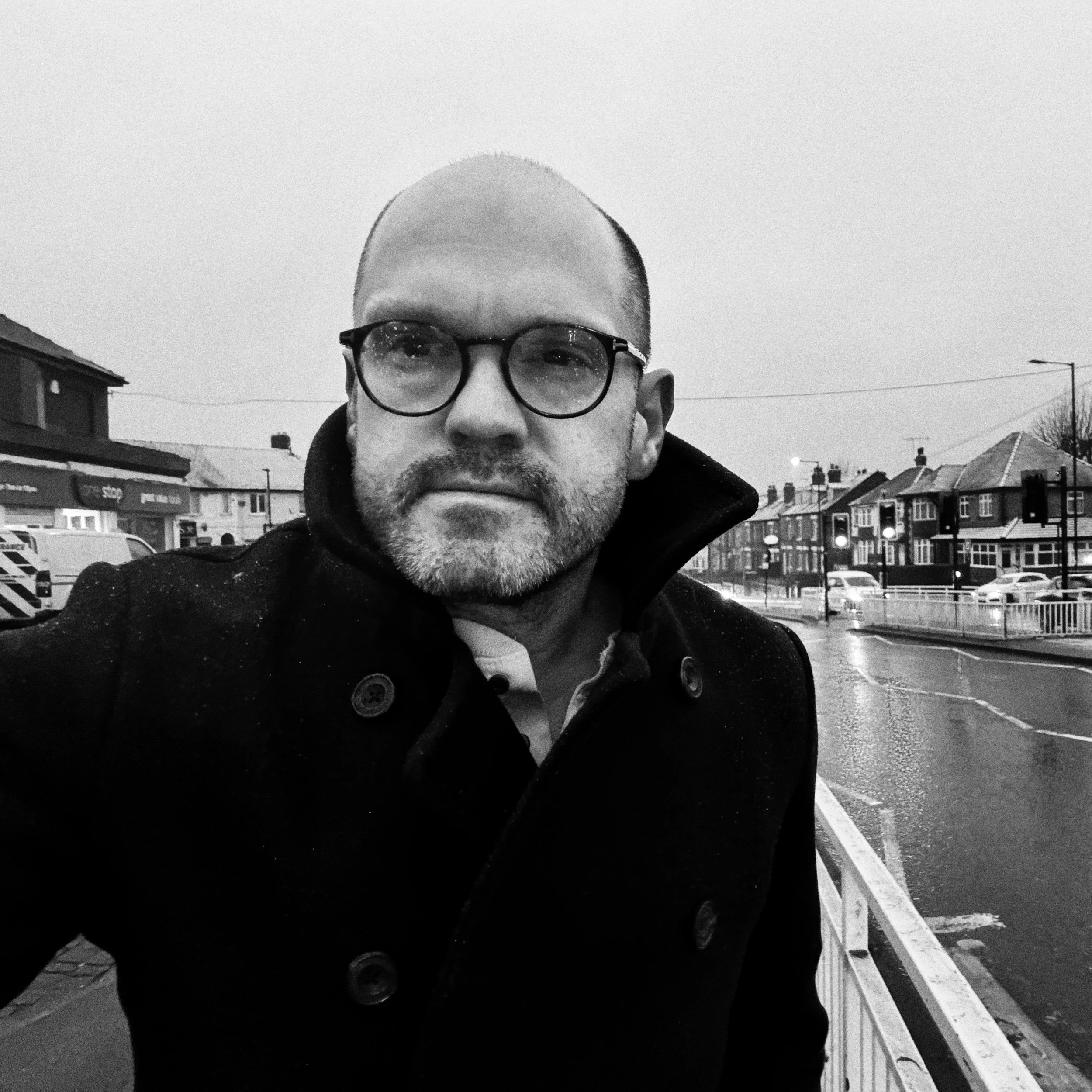
About me
I currently work in professional services at the University of Sheffield, where I specialise in knowledge exchange and impact – two of those terms that make no sense outside of higher education – and project and programme management (if you haunt the platform you can find me on LinkedIn). I’m an early modern historian by training and background; I was awarded my PhD at the University of Warwick for a thesis on inns, taverns, and alehouses in the seventeenth century, and have worked on several big research projects on related themes, most recently on ‘new’ intoxicants (chocolate, coffee, opium, sugar, tea, and tobacco) in early modern Europe. I still dabble in history writing for a public audience – see recent(ish) pieces on tea gardens, gin shops, and the smell of seventeenth-century coffeehouses – and have occasional side hustles in web design, graphic design, and videography.
What is Dark Frames?
In 2016, I moved to Norwich to work at the University of East Anglia on a research project called Inner Lives, which was about the history of witchcraft, magic, and the emotions. And, for the first time since I was in my teens – when, for a GCSE art project, I ambushed a local monastery with a neighbour’s creaking Pentax – I found myself taking photographs. They all had a distinctly dark flavour, in terms of both subject matter and style. There are various reasons for this, but I think the project’s emphasis on the supernatural and feeling states, in combination with the unique history and characteristics of the East Anglian landscape (an environment suffused with melancholy strangeness), fired my visual and creative imagination. I’ve also had longstanding research interests in the role of space, place, and material things in shaping human interaction, experience, and memory; in psychogeography and landscape phenomenology; and in difficult heritage and dark tourism.
Thus, what started with a pilgrimage to the famed Sheringham Mermaid one chilly Saturday in late 2016 has resulted – many years and expeditions later – in a fairly extensive archive of creepy captures, which continues to expand, and which I thought perhaps warranted their own shadowy corner of the internet to call home. My work is organised across seven long-term thematic projects, which – in a Ronseal approach – I’ve called the urban weird, ruins and abandoned places, eerie nature, haunted histories and dark pasts, sites of witchcraft, folklore and landscape legends, and churches and graveyards. There’s much border energy between the collections, and many of my images could go into more than one gallery; where this is the case, I’ve chosen the one that seemed to suit them best.
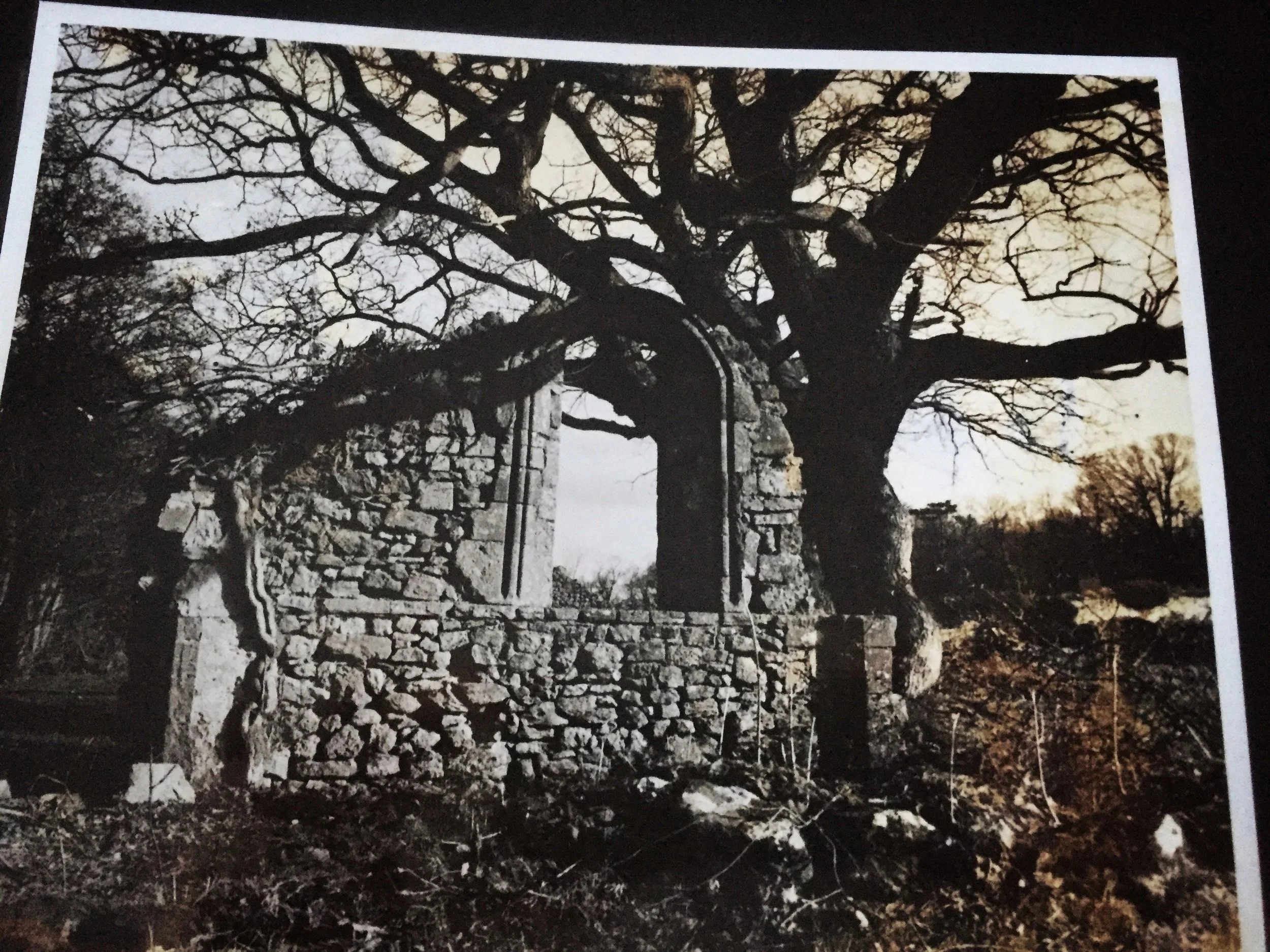
A moody print photograph made for a GCSE art project. Quarr Abbey, Ryde, Isle of Wight.
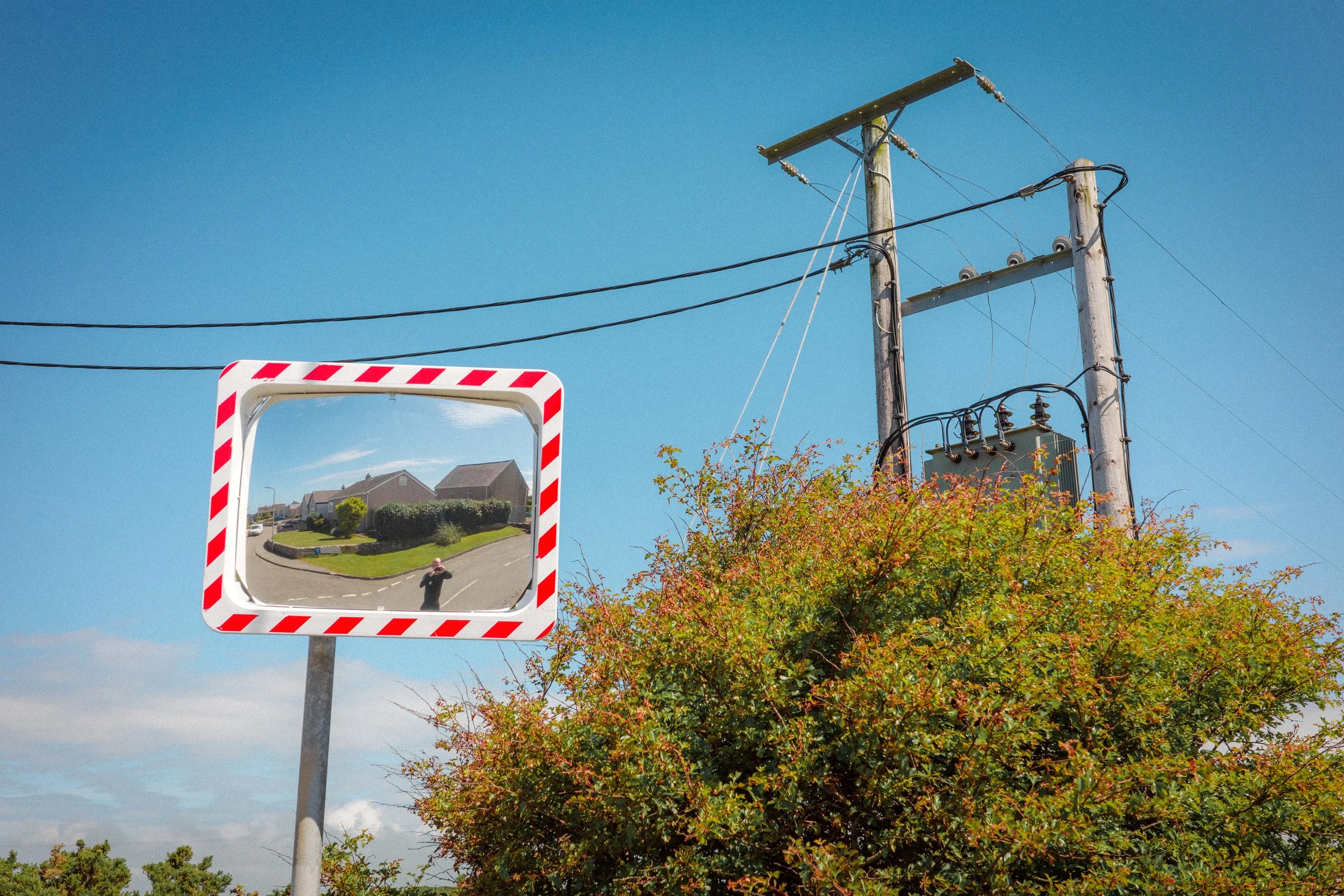
Out and about. Llanfaelog, Anglesey, Wales.
Inspirations and credits
First and foremost is the work of Simon Marsden, an innovative photographer who specialised in the atmospheric black and white depiction of gothic buildings and scenes across Britain and Europe; a master of printing and darkroom techniques, he would have hated that I shoot digital. I also love the off-kilter urban and rural landscapes of (amongst many others) Eugène Atget, William Eggleston, Frederick H. Evans, Lee Friedlander, Fay Godwin, Clarence John Laughlin, John Margolies, Léonard Misonne, Peter Mitchell, Raymond Moore, Edwin Smith, and Josef Sudek, and practitioners of the New Topographics. With dreary predictability I’m heavily influenced by folk horror films, novels, and short stories, while I’ve benefited from the inspiration and support of the #FolkloreThursday hashtag and community (originally on Twitter as it then was, now transplanted to the more congenial surroundings of Bluesky). More food for thought has been provided by those strange and inimitable counties of Hookland and Scarfolk, and my favourite contemporary artists and photographers, especially Sarah Coomer, Catherine Gogerty, Anni Jyn, Lee Madgwick, James Popsys, Nick Stone, and Richard Wells, whose work adorns my walls. If you like my vibe you’ll also very much enjoy theirs.
In terms of location research, a key part of my process, the Hidden East Anglia website opened up an invisible world of curiosities on my then-doorstep, while Simon Knott’s meticulous and exhaustive documentation of the churches of the eastern counties – see his websites on Essex, Norfolk, and Suffolk – allowed me to identify the kinds of macabre and sinister details that appeal to my sensibilities (as did, on a nationwide scale, the vast photographic project of Robin Farquhar–Thomson). The websites Atlas Obscura, Flickering Lamps, Ludchurch, The Modern Antiquarian, The Paranormal Database, and Urbexology are also fascinating troves of eldritch locales, as are the travel book series 111 Places (especially Dr Philip Stone’s instalment on dark places); the wonderful hand-illustrated walking guides of Christopher Goddard; and, from the excellent Wild Things imprint, Dave Hamilton’s guide to Wild Ruins and Rob Wildwood’s atlas of Magical Places in Britain. Rob’s enormous photographic archive of enchanted sites in the UK and further afield can also be enjoyed via his website.
More personally, huge thanks to my sister Rebecca, who uncomplainingly accompanied me to a vast number of cursed locations across the north during the lockdown era; one particularly memorable excursion, very early in the pandemic, saw us driving on a deserted A1 to the Swaledale Corpse Way in the Yorkshire Dales while Do Not Travel injunctions flashed on overhead signs and issued from the radio (I had a generous interpretation of ‘essential journey’). In more recent years my wonderful girlfriend Lynne has been the perfect co-explorer and partner in crime. Finally, thanks are due Professor Malcolm Gaskill, leading witchcraft scholar and Principal Investigator on the Inner Lives project, who was unfailingly encouraging of my weird weekends – which I related in sometimes punishing detail – and who first introduced me to the work of Simon Marsden via the gift of three of his books.
Select bibliography
Should a photography portfolio have a bibliography? Of course it should. As well as the texts and resources mentioned above, the following articles and books have shaped my interests and approach.
K. Brophy, ‘Selfish Walks’, The Urban Prehistorian (21 January 2017).
W. Burns, Ghost of an Idea: Hauntology, Folk Horror and the Spectre of Nostalgia (London, 2025).
R. Clarke, A Natural History of Ghosts: 500 Years of Hunting for Proof (London, 2012).
H. Cornish, ‘In Search of the Uncanny: Inspirited Landscapes and Modern Witchcraft’, Material Religion 16 (2020): 410–31.
T. Cox, 21st-Century Yokel (London, 2017).
M. de Certeau, The Practice of Everyday Life (Berkeley, 1984 [trans. S. Rendall]).
C. Flynn, Islands of Abandonment: Life in the Post-Human Landscape (London, 2021).
R. Halstead, J. Hazeley, A. Morris, & J. Morris, Bollocks to Alton Towers: Uncommonly British Days Out (London, 2005).
J. Harte, Cloven Country: The Devil and the English Landscape (London, 2022).
C. Larrington, The Land of the Green Man: A Journey Through the Supernatural Landscapes of the British Isles (London & New York, 2015).
H. Lefebvre, The Production of Space (Oxford, 1991 [trans. D. Nicholson-Smith]).
J. Lennon & M. Foley, Dark Tourism: The Attraction of Death and Disaster (London & New York, 2000).
E. Parnell, Ghostland: In Search of a Haunted Country (London, 2019).
P. Ross, A Tomb with a View: The Stories and Glories of Graveyards (London, 2020).
W. G. Sebald, The Rings of Saturn (London, 1998 [trans. M. Hulse]).
A. Scovell, Folk Horror: Hours Dreadful and Things Strange (Leighton Buzzard, 2017).
C. Tilley, A Phenomenology of Landscape: Places, Paths, and Monuments (Oxford, 1994).
G. M. Trevelyan, ‘Walking’, in idem, Clio, a Muse, and Other Essays Literary and Pedestrian (London & New York, 1913), pp. 56–81.
The Science Bit
Earlier images on this site were made with a Sony A6000 on Zeiss Vario-Tessar 16-70mm F4 and Zeiss Sonnar 55mm F1.8 lenses. I’ve subsequently changed/upgraded to a Panasonic LUMIX S5II with LUMIX S 20–60mm F3.5–5.6, LUMIX S 50mm F.1.8, and LUMIX S 85mm F1.8 lenses but still use the Sonnar with a Sony Alpha 7 II as a backup, and to mix things up (this duplicated the form and function of my main system and was gathering dust so I’ve replaced it with a Ricoh GR IIIx as an everyday/stealth carry). I always shoot in RAW, and edit my photographs in Adobe Lightroom across desktop, laptop, tablet, and phone depending on location and mood. I flatly refuse to use a tripod.
Contact me
To order a high-resolution print of or to licence any of my images, to discuss a potential collaboration or project, for more information about a particular location, or to flag a howler in any of the blog posts or captions (I am congenitally error-prone), feel free to contact me on drjamesrbrown@gmail.com. I also occasionally lurk on Bluesky.